What We Found When We Checked 9,354 German Online Retailers
We spent the past week running a systematic health check across every German online retailer in our database. 9,354 shops. One request each, repeated daily. Here is what we found.
── THE NUMBERS ──────────────────────────────────────────────
Of 9,354 shops monitored, 9,091 are active and responding — 97.2%. 16 are under observation (unreachable for 1–7 days). 248 are in quarantine (unreachable for 8–30 days). Zero are inactive.
The 97.2% figure is not a marketing claim. It is the output of a daily automated HTTP check, logged with timestamps, publicly visible at app.inputintel.com/database-health.
When we ran the first version of this check in late March, the apparent offline rate was closer to 11%. That figure was misleading. A significant portion of shops flagged as unreachable were returning HTTP 403 — the standard response when a server blocks automated requests. Saturn, Amazon, Bauhaus, and hundreds of other operational retailers block HEAD requests from unknown user agents as routine security policy.
After correcting for this and adding a retry pass with a browser-realistic user agent, the genuine problem population dropped to what you see above.
── THE HANDELSREGISTER FINDING ──────────────────────────────
While running the health check, we also cross-referenced our database against the German Handelsregister — the official commercial register containing 5.3 million registered entities.
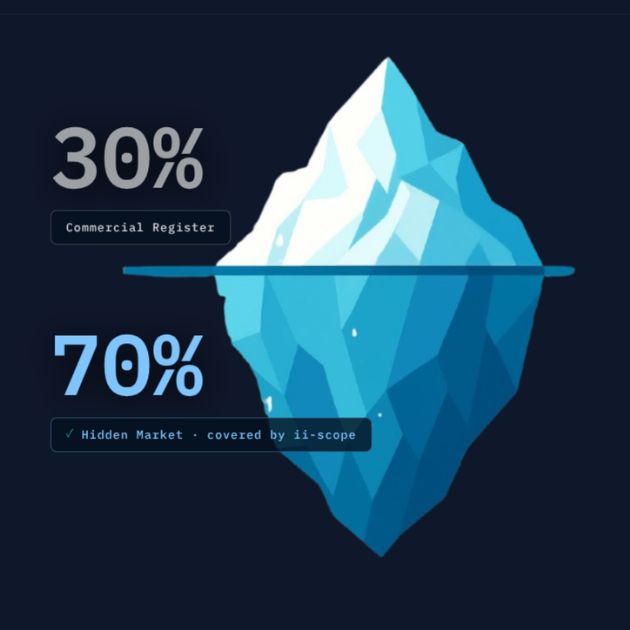
The result was direct: 29.7% of the German online retailers in our database appear in the Handelsregister. The remaining 70.3% do not.
This is not a data quality problem. It is a structural feature of the German retail market.
The majority of German online retailers operate as sole traders (Einzelunternehmer), civil-law partnerships (GbR), or micro-businesses below the €600,000 annual revenue threshold that triggers mandatory registration in the commercial register. They are legally operating, actively selling, and in many cases highly loyal to the brands they carry — precisely because they are not large enough to attract the attention of major brand managers.
Every major B2B database covers the Handelsregister. That is 30% of German e-commerce.
We cover the other 70%, too.
── WHY THIS MATTERS FOR MARKET ENTRY ────────────────────────
The conventional approach to entering the German market focuses on registered entities: GmbH, AG, established chains. This makes sense if the objective is volume through a single channel.
It makes less sense if the objective is breadth of market presence, brand recognition, or low-risk product testing.
Consider the arithmetic:
One large retailer. Minimum order 500 units. 90-day payment terms. A category buyer who receives 40 supplier pitches per week.
Versus: fifty small retailers, 10–20 units each, owner-operated, decision made in the same conversation.
For brands from markets newly entering preferential trade agreements — Mercosur, India, Indonesia — the small retailer tier is structurally more accessible than it has ever been. Reduced tariff friction on small consignments changes the economics of wide distribution. A brand can achieve market presence across 50 retail points before it has negotiated a single framework agreement with a major category buyer.
This is not a fallback strategy. For early-stage market entry, it is often the correct one.
── A NOTE ON METHODOLOGY ────────────────────────────────────
Our health check uses a two-step approach: HEAD request first, followed by GET where HEAD is blocked. This eliminates false positives from shops that block automated requests as standard security policy.
The Handelsregister cross-reference uses FTS5 full-text search against the OpenRegister dataset (March 2026 release, 5,305,727 entries). Matching is performed on company name after stripping legal form suffixes. The 29.7% figure is therefore a lower bound — shops operating under a trading name different from their registered company name will not match.
── CLOSING ───────────────────────────────────────────────────
We publish these findings not as marketing, but because the data is factually interesting and because transparency about data quality is, in our view, part of what intelligence means.
A database that claims 9,200 active German retailers without telling you how many are actually reachable today is not an intelligence product. It is a list.
We intend to be the former.
—
ii-scope.com | Verified German E-Commerce Intelligence
Related tool
Find the right German retailers — verified, enriched, actionable.
ii-scope gives you 9,200+ verified German e-commerce retailers with AI-enriched profiles. Browse free, subscribe when you're ready.
Explore ii-scope →